The Ames Room, how your brain gets tricked by perspective
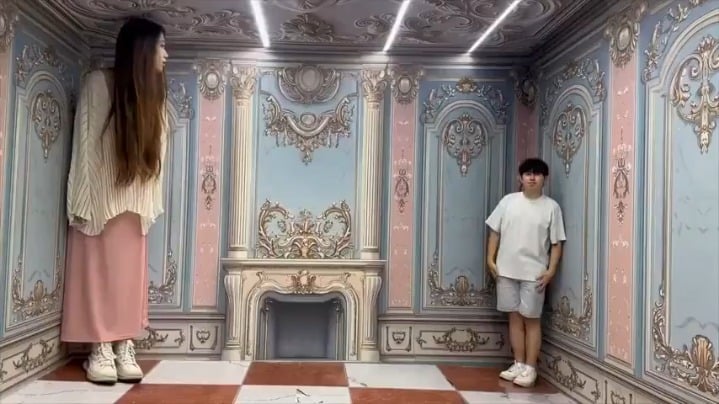
Have you ever walked into a room that seemed completely normal, only to realize that something was off? The furniture looked a bit wonky, and the people in the room seemed to be different sizes. You might have experienced something similar to the Ames Room, a cleverly designed space that tricks your brain into seeing things that aren’t really there. This mind-bending phenomenon has been fascinating people for decades, and it’s a great example of how our brains can be fooled by perspective.
The Science Behind the Ames Room
The Ames Room is a type of distorted room that was first created by Adelbert Ames Jr. in 1935. Ames was an American ophthalmologist who was interested in the way that our brains process visual information. He designed the room to be a trapezoid, with the back wall and the floor slanted at an angle. This creates a distorted perspective that makes it difficult for our brains to accurately judge the size and distance of objects in the room. When you look through a peephole into the Ames Room, you see a distorted version of reality, where people and objects appear to be different sizes and shapes. It’s a really disorienting experience, and it’s a great example of how our brains can be tricked by perspective.
How the Ames Room Tricks Your Brain
So, how does the Ames Room manage to trick our brains so effectively? It all comes down to the way that we process visual information. When we look at the world, our brains use a combination of cues to judge the size and distance of objects. These cues include things like the size of the object, its color and texture, and the way that it relates to other objects in the scene. In the Ames Room, these cues are all distorted, which makes it difficult for our brains to accurately judge the size and distance of objects. For example, if you see a person standing in the room, your brain might think that they are closer or farther away than they really are, based on the distorted perspective. This can create some really bizarre and disorienting effects, like making a person appear to shrink or grow as they move around the room.
Real-World Applications of the Ames Room Effect
The Ames Room might seem like a clever parlor trick, but it actually has some real-world applications. For example, architects and designers use similar techniques to create the illusion of larger or smaller spaces. This can be especially useful in small apartments or rooms, where a cleverly designed layout can make the space feel more spacious. The Ames Room effect is also used in film and theater to create the illusion of different environments and settings. By using distorted perspective and clever camera angles, filmmakers can create the illusion of a much larger or more elaborate set than is actually there. It’s a really powerful tool, and it’s a great example of how our brains can be tricked by perspective.
As you can see, the Ames Room is a really fascinating phenomenon that can teach us a lot about how our brains process visual information. It’s a great example of how perspective can be used to trick our brains, and it has some really interesting real-world applications. So, next time you’re walking through a room that seems a bit off, take a closer look – you might just be experiencing the Ames Room effect for yourself!