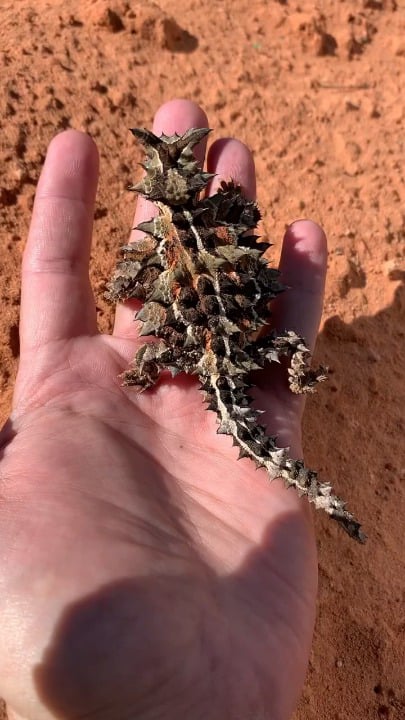
“Thorny devil”, a highly specialized, slow-moving lizard native to the arid scrublands and deserts of Australia.
Imagine walking through the scorching hot deserts of Australia, the sun beating down on your skin, and suddenly you spot a tiny, spiky creature making its way slowly across the sand. This is the thorny devil, a highly specialized and fascinating lizard that has adapted to life in one of the harshest environments on Earth. With its unique appearance and intriguing behaviors, the thorny devil is a true marvel of nature. Its body is covered in hard, thorn-like protrusions, and it has a distinctive “false head” on the back of its neck, which it uses to distract predators. But there’s more to this little lizard than meets the eye, and its story is one of remarkable survival and adaptation.
The Thorny Devil’s Desert Home
The thorny devil is found in the arid scrublands and deserts of western Australia, where the sun can reach temperatures of up to 120 degrees Fahrenheit in the summer. This is a challenging environment for any animal, with limited food and water resources, and a constant threat from predators. But the thorny devil has evolved a range of specialized features that enable it to thrive in this environment. Its spiky body, for example, helps to deter predators, while its false head provides an extra layer of protection. The thorny devil is also able to collect water on its body, which it then channels to its mouth for drinking. This unique ability allows it to survive for long periods without water, making it one of the most resilient animals in the desert.
Diet and Foraging
Despite its small size, the thorny devil has a surprisingly varied diet, which includes ants, beetles, and other small insects. It uses its long, sticky tongue to catch its prey, and its powerful jaws to crush the exoskeletons of its victims. The thorny devil is also able to eat a large quantity of food relative to its body size, which helps to sustain it during periods of food scarcity. In the wild, thorny devils can be seen foraging for food in the early morning and late afternoon, when the temperature is cooler and the insects are more active. This behavior helps to minimize its exposure to the heat, and reduces its risk of dehydration.
Conservation Status
Unfortunately, the thorny devil is facing a range of threats in the wild, including habitat destruction, climate change, and the introduction of invasive species. Its population is declining in some areas, and conservation efforts are underway to protect this unique and fascinating animal. The Australian government has established a number of protected areas, where the thorny devil and its habitat are safeguarded from human activities. Additionally, researchers are working to study the thorny devil’s behavior, ecology, and population dynamics, in order to better understand its needs and develop effective conservation strategies.
As we learn more about the thorny devil and its incredible adaptations, we are reminded of the importance of preserving our natural world. This remarkable little lizard has evolved over millions of years to thrive in one of the harshest environments on Earth, and its story is a testament to the incredible diversity and resilience of life on our planet. By protecting the thorny devil and its habitat, we are not only safeguarding the future of this unique species, but also preserving the delicate balance of the desert ecosystem, and all the amazing creatures that call it home.