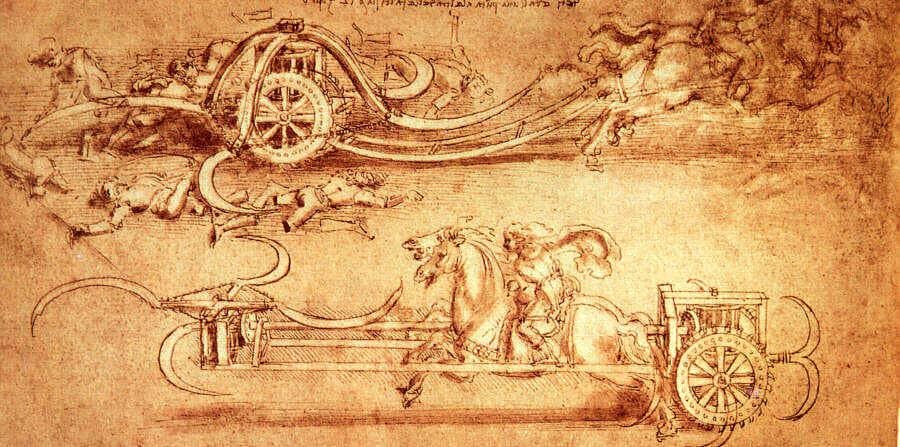
Da Vinci’s “Scythed Chariot” concept, basically a horse-drawn blender for enemy infantry
Imagine a medieval battlefield, with knights in armor and horses galloping everywhere – and then, out of nowhere, a strange, menacing contraption appears, leaving a trail of destruction in its wake. This isn’t a scene from a fantasy movie, but rather a glimpse into the ingenious and sometimes downright bizarre mind of Leonardo da Vinci, the Renaissance master who brought us iconic works like the Mona Lisa and The Last Supper. One of his most fascinating, and somewhat unsettling, concepts is the “Scythed Chariot,” a horse-drawn vehicle designed to mow down enemy infantry with its spinning blades – essentially, a horse-drawn blender for people.
The Concept and Design
Da Vinci’s Scythed Chariot was designed to be a formidable weapon on the battlefield, with a series of spinning blades attached to a central axis, powered by horses or other animals. The idea was that the chariot would be driven into the midst of enemy lines, where the spinning blades would wreak havoc on anyone who got too close. The design was remarkably detailed, with Da Vinci considering factors like the strength and durability of the materials, the speed and maneuverability of the chariot, and even the psychological impact on the enemy. While the Scythed Chariot may seem like a monstrous device to modern eyes, it’s a testament to Da Vinci’s boundless creativity and his willingness to think outside the box – or in this case, the battlefield.
Historical Context and Inspiration
The Scythed Chariot wasn’t just a product of Da Vinci’s fevered imagination – it was also rooted in the military technology of his time. During the Renaissance, warfare was becoming increasingly brutal and mechanized, with the introduction of firearms, cannons, and other deadly devices. Da Vinci’s design was likely inspired by the scythed chariots used by ancient armies, such as the Persian Empire, which used them to devastating effect against enemy infantry. At the same time, the Scythed Chariot reflects Da Vinci’s fascination with machines and mechanisms, as well as his deep understanding of human anatomy and psychology. By combining these different threads, Da Vinci created a concept that was both a product of its time and a precursor to the modern era of mechanized warfare.
Legacy and Impact
While the Scythed Chariot may never have been built or used in battle, it remains a fascinating footnote in the history of warfare and technology. Da Vinci’s design has inspired countless artists, inventors, and engineers over the centuries, and continues to capture the imagination of people around the world. At the same time, the Scythed Chariot serves as a reminder of the darker aspects of human ingenuity, and the ways in which our creativity and innovation can be used for destructive purposes. As we look back on Da Vinci’s remarkable legacy, we’re reminded that even the most brilliant minds can have a darker side – and that the true test of our ingenuity lies not in our ability to create, but in our ability to use our creations for the greater good.
As we gaze upon Da Vinci’s sketches of the Scythed Chariot, we’re struck by the sheer audacity of his vision, and the ways in which his imagination continues to inspire and unsettle us to this day. Whether we see the Scythed Chariot as a monstrous device or a brilliant innovation, it remains a powerful reminder of the boundless creativity and ingenuity of the human spirit – and the endless possibilities that await us when we combine art, science, and imagination in pursuit of a common goal.