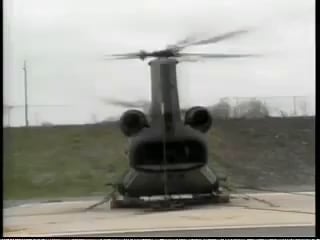
A Boeing CH-47 Chinook tearing itself apart during a ground resonance test
I still get goosebumps thinking about the infamous Boeing CH-47 Chinook ground resonance test that went horribly wrong. It’s a fascinating tale of science, engineering, and a healthy dose of unpredictability. The test, which took place in the 1960s, was designed to push the Chinook to its limits and see how it would perform under extreme conditions. But what happened next was something that no one could have anticipated – the helicopter literally tore itself apart, leaving a trail of destruction and debris in its wake. As I delved deeper into the story, I couldn’t help but wonder what had gone so terribly wrong.
The Science Behind Ground Resonance
The ground resonance test is a critical part of a helicopter’s development process. It’s designed to test the aircraft’s ability to withstand the intense vibrations that occur when the rotors are spinning. These vibrations can cause the helicopter to oscillate violently, leading to a phenomenon known as ground resonance. When a helicopter experiences ground resonance, its rotors can become synchronized with the natural frequency of the aircraft, causing it to shake and vibrate even more violently. In the case of the Chinook, the test was meant to simulate the conditions that the helicopter would experience during takeoff and landing. But as the test progressed, something strange began to happen – the helicopter’s rotors started to synchronize with each other, causing the aircraft to shake and vibrate with increasing intensity.
A Catastrophic Failure
As the test reached its climax, the Chinook’s rotors were spinning at an incredible 300 rpm. The aircraft was shaking and vibrating so violently that it was almost impossible to stand near it. And then, in an instant, disaster struck. The helicopter’s rotors became synchronized with each other, causing the aircraft to experience a catastrophic case of ground resonance. The resulting vibrations were so intense that they caused the helicopter’s airframe to literally tear itself apart. The test ended in a shower of sparks and debris, with the Chinook’s wreckage strewn across the test site. It was a sobering reminder of the importance of thorough testing and the unpredictable nature of complex systems.
Lessons Learned
Despite the dramatic failure of the ground resonance test, the Boeing CH-47 Chinook went on to become one of the most successful and enduring helicopter designs in history. The lessons learned from that fateful test were invaluable, and they helped to shape the development of future helicopters. Today, the Chinook remains in service with militaries around the world, a testament to the power of perseverance and the importance of pushing the boundaries of what is possible. As I look back on the story of the Chinook’s ill-fated ground resonance test, I am reminded of the incredible complexity and beauty of the natural world. Even in failure, there is always something to be learned, and it’s this sense of curiosity and wonder that drives us to keep exploring, keep pushing, and keep striving for greatness.
As I reflect on the story of the Boeing CH-47 Chinook’s ground resonance test, I am struck by the sheer power and complexity of the forces at play. It’s a reminder that even in the most carefully controlled environments, there is always an element of unpredictability, a sense that anything can happen at any moment. And it’s this sense of wonder and awe that keeps me coming back to stories like this, eager to learn more about the fascinating world of science and engineering that surrounds us.