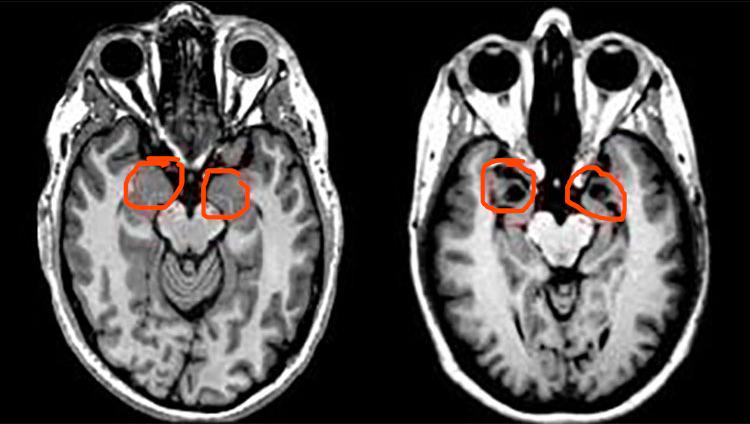
A brain scan of a typical brain (left) compared to an anonymous patient known as S.M. Patient S.M. was born with a condition called Urbach-Wiethe disease, which damaged her amygdala and left her virtually incapable of feeling fear.
Imagine being able to walk through a haunted house or watch a scary movie without feeling even a hint of fear – sounds like a superpower, right? Well, for one woman, known only as S.M., this is her reality. A brain scan comparison between a typical brain and S.M.’s brain reveals some astonishing differences, particularly in the amygdala, the part of the brain responsible for processing emotions like fear. This unusual condition has left scientists fascinated and eager to learn more about the intricacies of the human brain.
The Condition: Urbach-Wiethe Disease
So, what exactly is Urbach-Wiethe disease, and how does it affect the brain? This rare genetic disorder is characterized by a buildup of abnormal proteins in various parts of the body, including the brain. In S.M.’s case, the disease damaged her amygdala, a small almond-shaped structure that plays a crucial role in processing emotions, especially fear. As a result, S.M. is virtually incapable of feeling fear, even in situations that would normally send her running for cover. But what does this mean for her daily life, and how does she navigate the world without the fear response that most of us take for granted?
Life Without Fear
For S.M., life without fear is not necessarily a blessing. While she may not experience the debilitating anxiety that many people face, she also lacks the fear response that helps keep us safe. For example, when shown a series of scary movies, S.M. reported feeling nothing, not even a slight twinge of fear. She has also been known to approach wild animals, like snakes and spiders, without hesitation, putting herself in potentially dangerous situations. This lack of fear response has significant implications for her daily life, and scientists are still working to understand the full extent of her condition. By studying S.M.’s brain and behavior, researchers hope to gain a deeper understanding of the neural mechanisms that underlie fear and anxiety, and how these emotions impact our daily lives.
Uncovering the Science
So, what can we learn from S.M.’s remarkable condition? By studying her brain and behavior, scientists are gaining valuable insights into the neural mechanisms that underlie fear and anxiety. The comparison between S.M.’s brain scan and a typical brain scan reveals significant differences in the amygdala, highlighting the critical role this structure plays in processing emotions. Further research into Urbach-Wiethe disease and its effects on the brain may also lead to new treatments for anxiety disorders and other conditions characterized by abnormal fear responses. As scientists continue to unravel the mysteries of the human brain, we may uncover even more surprising secrets about the complex and fascinating world of human emotions.
As we marvel at S.M.’s extraordinary condition, we are reminded of the incredible complexity and diversity of the human brain. While her lack of fear response may seem like a superpower to some, it also highlights the importance of fear in keeping us safe and guiding our behavior. As we continue to explore the intricacies of the human brain, we may uncover even more surprising secrets about the complex and fascinating world of human emotions, and perhaps, one day, we’ll be able to unlock the full potential of the human mind.