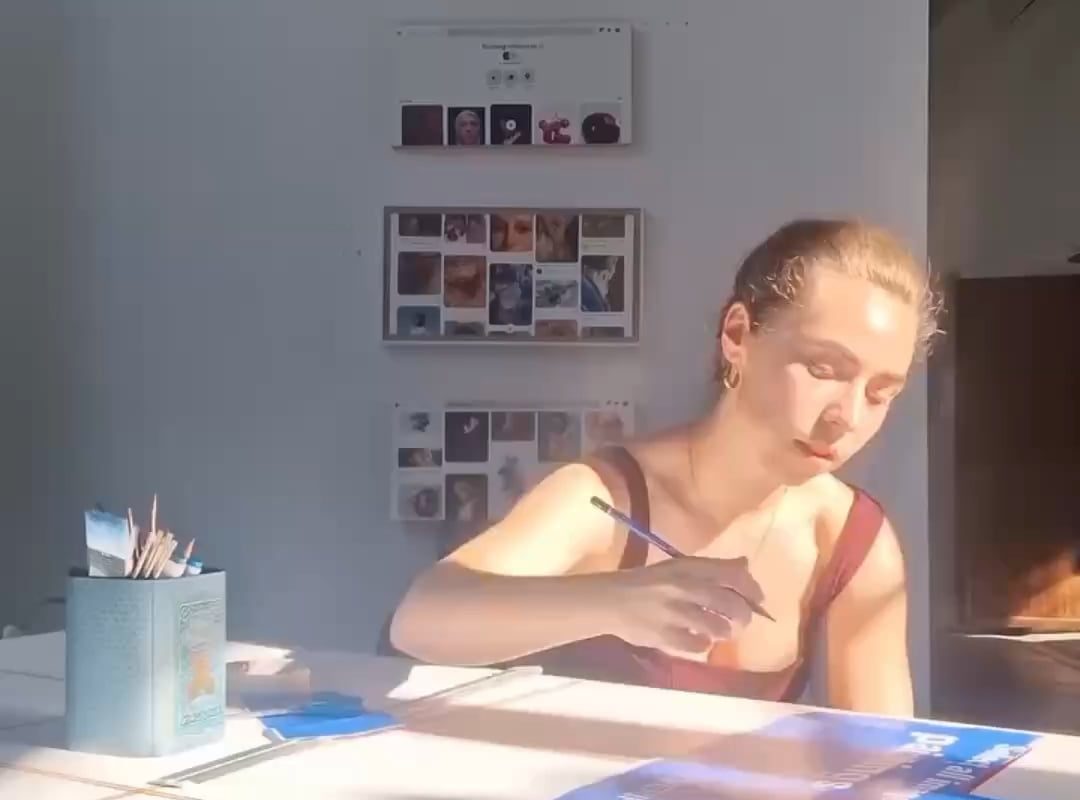
Credit to Mallorca based artist Marta Ruiz Anguera
I still remember the first time I stumbled upon the “I am not a robot” meta painting – it was like discovering a hidden treasure that sparked a flurry of questions in my curious mind. What does it mean to create a piece of art that explicitly states its own humanity, or rather, its lack thereof? Is it a commentary on our increasing reliance on technology, or a clever play on the blurred lines between human and machine? As I delved deeper into the story behind this fascinating artwork, I found myself entangled in a web of intriguing ideas and concepts that challenged my perceptions of creativity, consciousness, and what it means to be human.
The Artist’s Intent
The “I am not a robot” meta painting is a thought-provoking masterpiece that invites us to ponder the relationship between the creator and the created. By explicitly stating its own artificial nature, the painting raises important questions about authorship, intention, and the role of the artist in the creative process. Is the painting a genuine expression of human emotion, or is it simply a clever imitation of human-like qualities? The answer, much like the painting itself, remains ambiguous, leaving us to fill in the gaps with our own interpretations and biases. As we gaze upon the painting, we are forced to confront our own assumptions about the nature of creativity and the human experience.
The Science of Perception
From a scientific perspective, the “I am not a robot” meta painting offers a unique window into the workings of the human brain and its remarkable ability to recognize patterns and assign meaning. Our brains are wired to respond to certain visual cues, such as shapes, colors, and textures, which can evoke powerful emotions and associations. The painting, with its bold statement and clever use of visual irony, exploits these cognitive biases, creating a sense of tension and uncertainty that draws us in and refuses to let go. As we struggle to make sense of the painting’s paradoxical message, we are, in effect, participating in a fascinating experiment in perception and cognition, one that reveals as much about ourselves as it does about the artwork itself.
Beyond the Canvas
As I continued to explore the “I am not a robot” meta painting, I began to see it as more than just a clever artwork – it was a reflection of our collective anxieties and fears about the rapidly evolving relationship between humans and machines. In an era where artificial intelligence is increasingly capable of mimicking human-like qualities, the painting serves as a poignant reminder of the importance of empathy, creativity, and authentic human experience. As we navigate the uncharted territories of technological advancement, the “I am not a robot” meta painting stands as a powerful symbol of our shared humanity, a testament to the boundless potential of the human spirit to create, to inspire, and to challenge our assumptions about the world and our place within it.
As I finally tore myself away from the “I am not a robot” meta painting, I couldn’t help but feel a sense of awe and wonder at the intricate web of ideas and emotions that it had unleashed within me. The painting, much like a rich and complex novel, had become a mirror reflecting my own thoughts, biases, and assumptions, inviting me to confront the ambiguities and uncertainties of the human experience. And it is precisely this quality – its ability to inspire, to provoke, and to challenge our perceptions – that makes the “I am not a robot” meta painting a true masterpiece, one that will continue to fascinate and intrigue us for years to come.