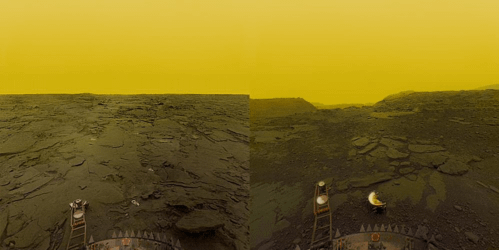
March 5, 1982: The Last Photos Ever Taken from the Surface of Venus. We’ve Never Returned.
The thought of sending a spacecraft to the surface of Venus, often referred to as Earth’s twin due to its similar size and proximity to the sun, is a daunting one. The planet’s extremely hostile environment, with surface temperatures reaching as high as 462 degrees Celsius and crushing pressures, makes it one of the most inhospitable places in our solar system. Yet, on March 5, 1982, the Soviet Union’s Venera 13 spacecraft accomplished the incredible feat of landing on Venus and sending back valuable data and photographs. What’s even more astonishing is that these photos remain the last ones ever taken from the surface of Venus, leaving us with a sense of wonder and a burning question – why have we never returned?
A Glimpse into the Unknown
The Venera 13 mission was a groundbreaking achievement that provided us with a unique glimpse into the unknown world of Venus. The spacecraft was designed to withstand the extreme conditions on the planet’s surface for a short period, and it managed to send back a treasure trove of information, including photographs, temperature readings, and data on the planet’s composition. The photos taken by Venera 13 show a barren, rocky landscape with numerous volcanic features, giving us a glimpse into the geological history of Venus. The mission was a remarkable success, and it paved the way for future space exploration, but it also left us with a sense of curiosity and a desire to learn more about our neighboring planet.
Challenges and Limitations
So, why have we never returned to the surface of Venus? The answer lies in the extreme challenges and limitations posed by the planet’s environment. The surface temperature and pressure on Venus are so extreme that they can melt lead and crush anything that tries to land on the planet. The atmosphere is also highly corrosive, making it difficult for spacecraft to survive for more than a few hours. These challenges have made it nearly impossible for spacecraft to land on Venus and send back data, let alone photographs. Despite these challenges, scientists and engineers continue to explore new technologies and mission designs that could potentially overcome these limitations and allow us to return to the surface of Venus.
A New Era of Exploration
Today, we are on the cusp of a new era of space exploration, with advances in technology and mission design that could potentially allow us to return to the surface of Venus. NASA and other space agencies are currently exploring new concepts and technologies that could enable us to send spacecraft to Venus and gather valuable data and photographs. The discovery of exoplanets and the search for life beyond our solar system have also renewed our interest in exploring our neighboring planets, including Venus. As we look to the future, we are reminded of the incredible achievements of the Venera 13 mission and the sense of wonder and curiosity that it inspired. The last photos ever taken from the surface of Venus remain a powerful reminder of the awe-inspiring beauty and mystery of our universe, and they continue to inspire us to explore and discover more.
The Venera 13 mission and the last photos ever taken from the surface of Venus are a testament to human ingenuity and the boundless curiosity that drives us to explore the unknown. As we continue to push the boundaries of space exploration, we are reminded of the incredible achievements of the past and the vast mysteries that still await us. The story of Venera 13 and the last photos from Venus is a fascinating one that continues to inspire us to reach for the stars and to never stop exploring.