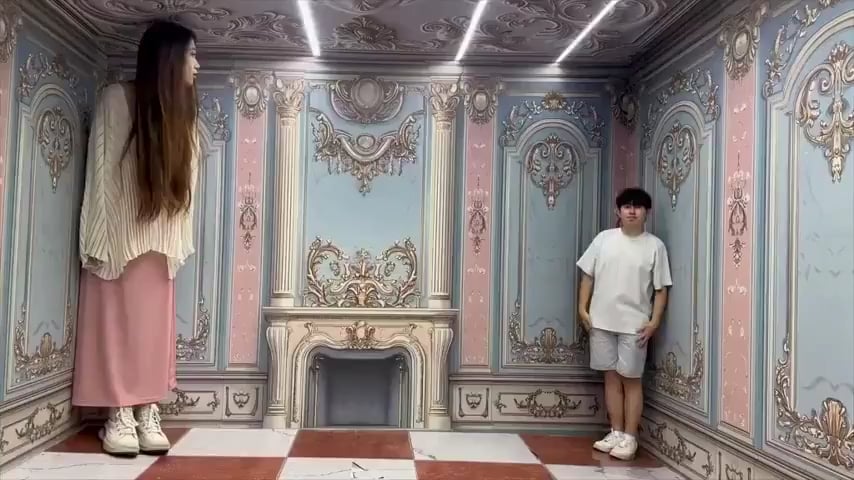
Optical illusion of Ames room
Have you ever walked into a room that seemed completely normal, only to realize that something was off? Maybe the furniture looked a bit wonky, or the walls seemed to be at strange angles. If so, you might be interested to learn about the Ames room, a fascinating optical illusion that has been fooling people for decades. This mind-bending phenomenon was first created in the 1930s by American ophthalmologist Adelbert Ames Jr., who was determined to show how easily our brains can be tricked into seeing things that aren’t really there.
The Science Behind the Illusion
The Ames room is a specially constructed space that uses a combination of distorted walls, floors, and ceilings to create a powerful optical illusion. When viewed from a specific angle, the room appears to be a normal, rectangular space. However, when people enter the room, they quickly realize that something is amiss. The room’s distorted proportions make it seem as though the people inside are changing size, with some appearing to be giant and others tiny. This illusion is made possible by the way our brains process visual information, using cues like perspective and proportion to create a mental map of the world around us. By manipulating these cues, the Ames room is able to create a convincing illusion that challenges our perceptions and leaves us wondering what’s real and what’s not.
A Brief History of the Ames Room
The Ames room has a fascinating history that dates back to the 1930s, when Adelbert Ames Jr. first created the illusion as part of an experiment on perception. Ames was a pioneering ophthalmologist who was interested in understanding how our brains process visual information. He created the room as a way to demonstrate the power of optical illusions and to challenge people’s assumptions about the world around them. Since then, the Ames room has been used in countless experiments and demonstrations, and has even been featured in films and television shows. Today, you can find Ames rooms in museums and science centers around the world, where they continue to amaze and delight visitors of all ages.
Experiencing the Ames Room for Yourself
If you’re curious about the Ames room and want to experience it for yourself, there are plenty of opportunities to do so. Many science museums and centers have Ames rooms that you can visit, and some even offer guided tours and explanations of the science behind the illusion. You can also find videos and photos of the Ames room online, which can give you a sense of what it’s like to experience the illusion firsthand. Whether you’re a science buff, a curious observer, or simply someone who loves a good puzzle, the Ames room is sure to delight and amaze you. So why not give it a try and see for yourself how easily your brain can be tricked into seeing things that aren’t really there?
As you can see, the Ames room is a fascinating phenomenon that continues to capture the imagination of people around the world. By manipulating our perceptions and challenging our assumptions, the Ames room reminds us that the world is not always as it seems, and that our brains are capable of playing some pretty clever tricks on us. So next time you walk into a room, take a closer look around – you never know what illusions might be lurking in the shadows, waiting to be discovered.