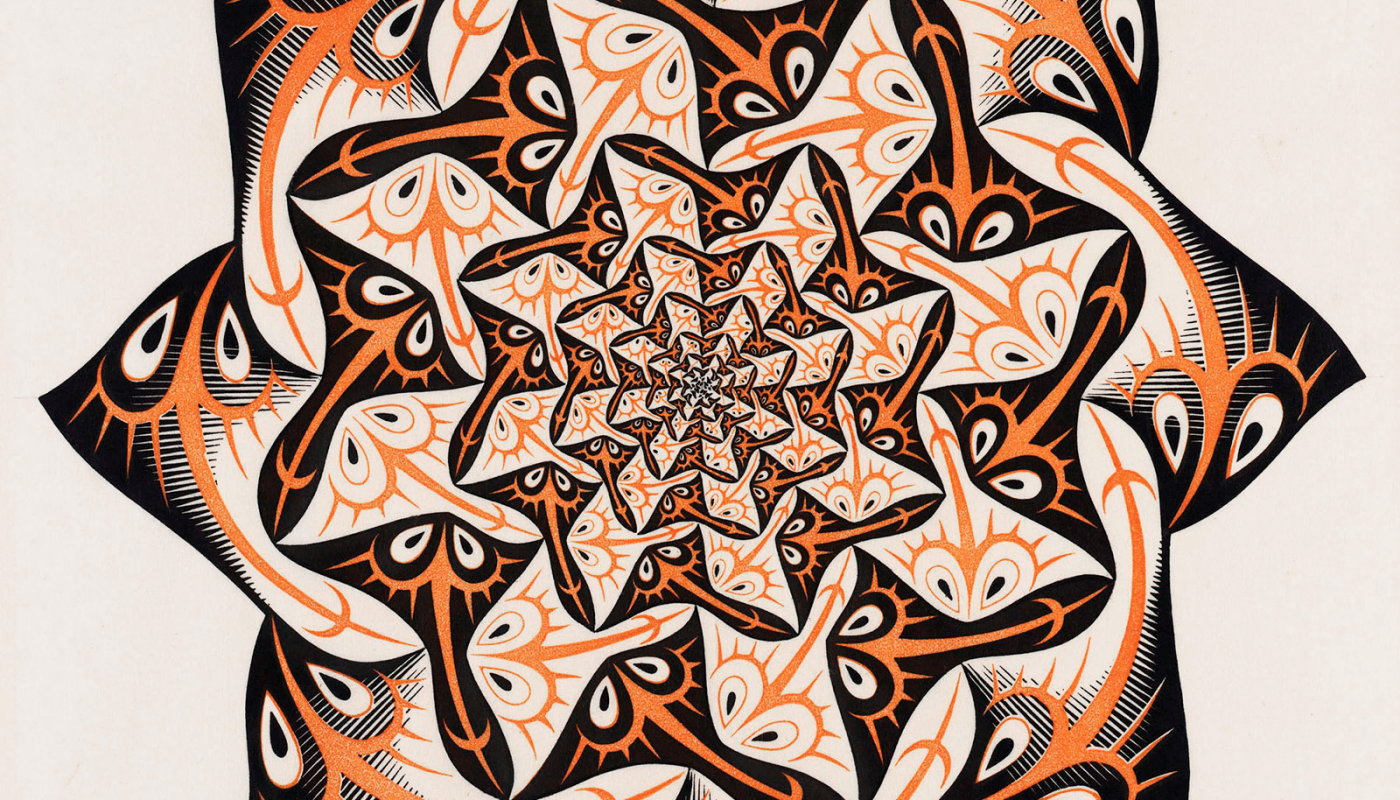
The hypnotic spiral of repeating shapes in an Escher print.
Have you ever found yourself mesmerized by the intricate patterns and shapes in an M.C. Escher print? Those hypnotic spirals of repeating shapes seem to draw you in, don’t they? It’s as if you’re being pulled into a world of endless possibility, where the laws of physics are gently bent and twisted. But what is it about these prints that’s so captivating? Is it the mathematical precision, the artistic flair, or something deeper? Let’s take a closer look at the fascinating world of Escher prints and uncover the secrets behind their enduring allure.
The Art of Tessellations
At the heart of Escher’s prints lies the concept of tessellations – repeating patterns of shapes that fit together without overlapping. This ancient art form has been used by cultures around the world, from the intricate mosaics of Islamic architecture to the colorful textiles of African tribes. But Escher took tessellations to a whole new level, using his mathematical skills to create mind-bending patterns that seem to shift and change before your eyes. His famous “Day and Night” print, for example, features a landscape that gradually transforms from day to night, using a clever combination of black and white tiles to create a sense of depth and movement.
The Science of Symmetry
So why do Escher’s prints have such a hypnotic effect on us? One reason lies in the science of symmetry. Our brains are wired to recognize patterns and symmetries, which is why we find repeating shapes so pleasing to the eye. Escher’s use of symmetry and tessellations taps into this deep-seated preference, creating a sense of order and harmony that’s both calming and exhilarating. But there’s more to it than just aesthetics – research has shown that symmetrical patterns can actually affect our mood and cognitive function, reducing stress and improving focus. No wonder we find ourselves getting lost in the swirling spirals of an Escher print!
Behind the Artist’s Mind
So what inspired Escher to create these mesmerizing prints? The artist himself was fascinated by the intersection of art and mathematics, and spent years studying the geometric patterns found in nature and architecture. His travels to the Alhambra palace in Spain, with its intricate Moorish tiles, had a profound influence on his work, and he went on to develop a unique style that blended mathematical precision with artistic flair. Today, Escher’s prints continue to inspire artists, designers, and scientists alike, offering a glimpse into a world of beauty and complexity that’s both familiar and strange.
As we gaze into the hypnotic spiral of an Escher print, we’re not just admiring a work of art – we’re experiencing a profound connection to the natural world, to the laws of mathematics and symmetry that govern our universe. It’s a reminder that art and science are not separate domains, but intertwined threads that weave together to create a richer, more wondrous tapestry of human experience. So the next time you find yourself entranced by an Escher print, remember that you’re not just looking at a pretty pattern – you’re glimpsing the hidden harmonies that underlie our world, and the boundless creativity of the human mind.