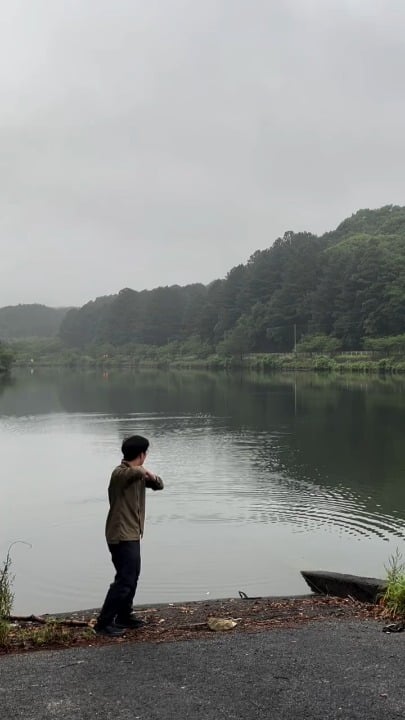
Credit: @tousekikai
The way this stone skims across the water is truly mesmerizing – it’s as if it’s dancing on the surface, leaving a trail of ripples in its wake. I’ve always been fascinated by this simple yet elegant phenomenon, and I’m sure I’m not alone. Who among us hasn’t stood by a lake or a river, picking up a flat stone and trying to skip it across the water, watching in delight as it bounces and spins? But have you ever stopped to think about the science behind this seemingly effortless motion? It’s actually a complex interplay of physics and gravity, and it’s what makes the stone’s journey so captivating.
The Art of Stone Skimming
So, what makes a stone skim across the water in the first place? It all comes down to the angle and speed at which it’s thrown. When you throw a stone at a shallow angle, it hits the water with a lot of horizontal velocity, which allows it to bounce across the surface. The stone’s spin also plays a crucial role – as it rotates, it creates a difference in air pressure above and below it, generating an upward force that helps it stay aloft. It’s a delicate balance, and even the slightest variation in technique can make all the difference between a stone that skims beautifully and one that sinks without a trace.
The Science of Ripples and Waves
As the stone skims across the water, it creates a series of ripples and waves that radiate outward from the point of impact. These ripples are actually a manifestation of the stone’s energy being transferred to the water – as the stone moves, it displaces the water molecules around it, creating a disturbance that propagates outward. The speed and distance of these ripples depend on factors like the stone’s size and weight, as well as the water’s surface tension and viscosity. It’s a remarkable example of how a small, localized event can have far-reaching effects, and it’s what makes the stone’s journey so visually striking.
A Timeless Pastime
Stone skimming has been a popular pastime for centuries, with evidence of it dating back to ancient civilizations in Egypt, Greece, and Rome. It’s a simple yet timeless activity that transcends cultures and ages, and one that continues to captivate us to this day. Whether you’re a child or an adult, there’s something undeniably appealing about the challenge of skimming a stone across the water – the thrill of watching it bounce and spin, the satisfaction of achieving a new record distance, and the joy of connecting with nature in a fun and playful way.
As I stand by the water’s edge, watching the stone skim across the surface, I’m reminded of the beauty and complexity of the natural world. It’s a world that’s full of hidden wonders and subtle mechanisms, and one that continues to inspire and delight us. So next time you’re out by a lake or a river, take a moment to appreciate the simple joy of stone skimming – and who knows, you might just discover a new passion that will stay with you for a lifetime.