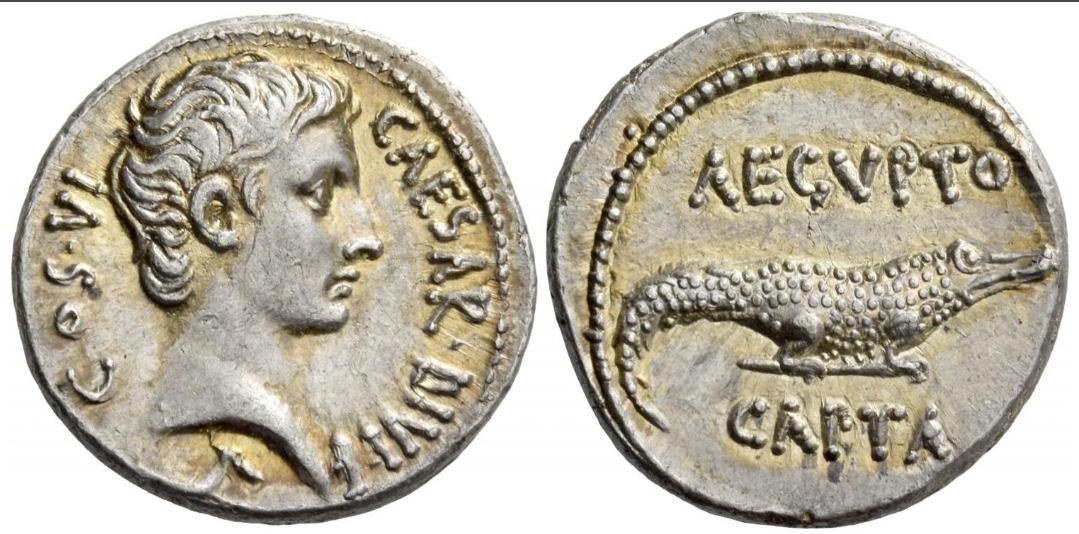
After the Roman Emperor Augustus defeated Anthony and Cleopatra at the Battle of Actium, he minted a series of coins celebrating his victory bearing the legend “AEGVPTO CAPTA” and a crocodile.
Imagine holding a piece of history in the palm of your hand, a tangible reminder of a pivotal moment that shaped the course of civilization. For collectors and historians, ancient coins are more than just relics of a bygone era – they’re windows into the past, offering a glimpse of the people, places, and events that defined a particular time and place. One such coin is the “AEGVPTO CAPTA” series, minted by Roman Emperor Augustus to commemorate his victory over Anthony and Cleopatra at the Battle of Actium. But what’s really fascinating about these coins is the symbolism behind them, particularly the image of a crocodile that appears alongside the legend.
The Battle of Actium: A Turning Point in History
The Battle of Actium, fought in 31 BCE, was a decisive naval engagement that marked the end of the Roman Republic and the beginning of the Roman Empire. Augustus, then known as Octavian, led the Roman forces to a crushing victory over the combined forces of Mark Anthony and Cleopatra, the last pharaoh of Ancient Egypt. The battle was a turning point in history, cementing Augustus’ position as the sole ruler of Rome and paving the way for the Pax Romana, a period of relative peace and stability that lasted for centuries. The “AEGVPTO CAPTA” coins, with their triumphant legend and symbolic imagery, were a way for Augustus to proclaim his victory to the world and assert his dominance over the newly conquered territory of Egypt.
The Symbolism of the Crocodile
So, why a crocodile? In ancient Roman culture, the crocodile was a symbol of Egypt, a fierce and exotic creature that represented the power and mystery of the Nile. By depicting a crocodile on his coins, Augustus was making a bold statement about his conquest of Egypt and his claim to its rich resources and strategic location. The crocodile also had connotations of danger and ferocity, emphasizing the idea that Augustus had tamed a wild and unpredictable land. But there’s more to the story than just symbolism – the crocodile may also have represented a very real aspect of Egyptian culture and daily life. In ancient Egypt, crocodiles were revered and feared in equal measure, with some species considered sacred and others seen as deadly predators.
A Lasting Legacy
Today, the “AEGVPTO CAPTA” coins are highly prized by collectors and historians, offering a tangible connection to a pivotal moment in history. But their significance goes beyond their rarity or monetary value – they represent a fascinating glimpse into the culture, politics, and symbolism of ancient Rome. As we hold these coins in our hands, we’re reminded of the complex web of meanings and associations that underpinned ancient Roman culture, and the ways in which art, literature, and even currency can be used to convey powerful messages and ideologies. Whether you’re a seasoned collector or just a curious enthusiast, the “AEGVPTO CAPTA” coins are a powerful reminder of the enduring legacy of ancient Rome, and the ways in which history can be found in the most unexpected places.
As we marvel at the beauty and craftsmanship of these ancient coins, we’re invited to reflect on the broader context in which they were created – a world of ancient empires, cultural exchange, and symbolic expression. The “AEGVPTO CAPTA” coins may be over 2,000 years old, but they remain a potent symbol of the power of history to shape our understanding of the world and our place within it. Whether you’re a historian, a collector, or simply someone who’s curious about the past, these coins offer a fascinating window into a bygone era, and a reminder of the enduring legacy of ancient Rome.