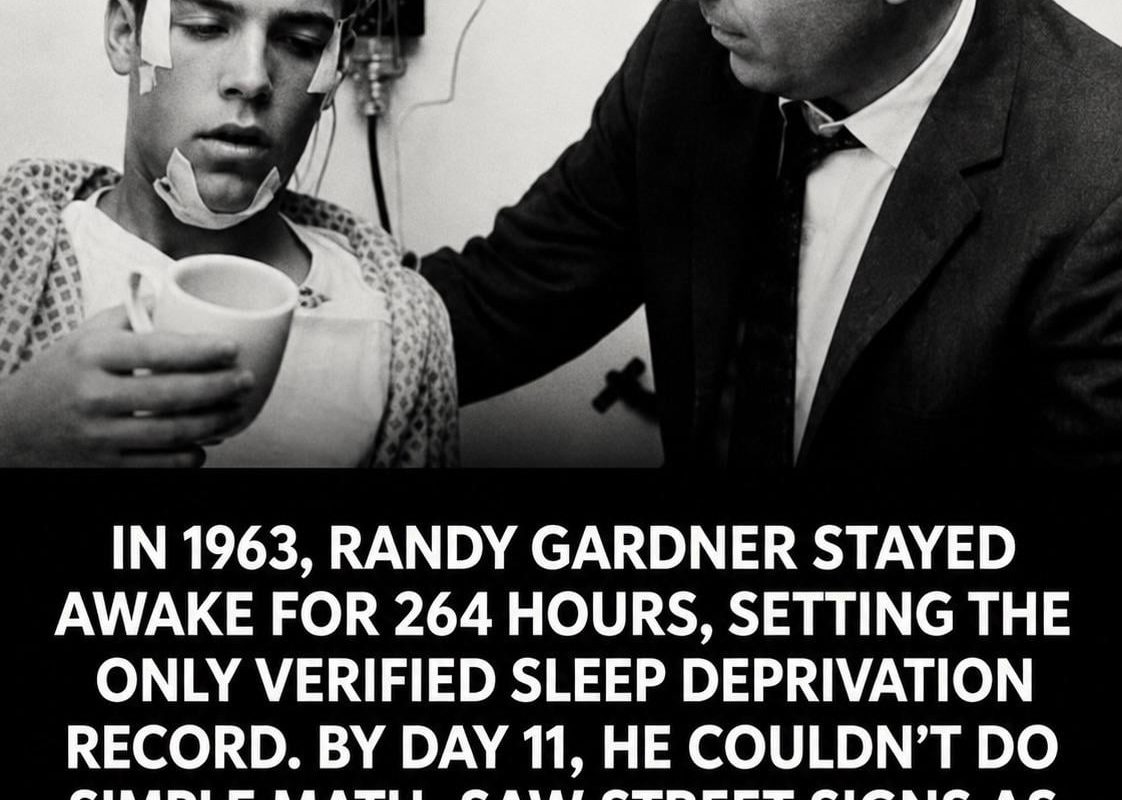
In 1963, Randy Gardner stayed awake for 264 hours (11 days) as part of a sleep-deprivation experiment.
Imagine going without sleep for 11 whole days – that’s 264 hours of being awake, alert, and aware, without so much as a catnap. Sounds impossible, right? Yet, in 1963, a high school student named Randy Gardner did just that, as part of a sleep-deprivation experiment that would test the limits of human endurance. Gardner’s feat has become the stuff of legend, and it’s still widely talked about today in scientific circles. But what drove him to take on this challenge, and what did scientists learn from his remarkable experiment?
The Experiment
Randy Gardner was just 17 years old when he decided to stay awake for 11 days, under the watchful eye of scientist William C. Dement. Dement, a renowned sleep researcher, was determined to study the effects of prolonged sleep deprivation on the human body. Gardner, who was a high school student at the time, was the perfect test subject – young, healthy, and eager to push his body to the limit. The experiment was simple: Gardner would stay awake for as long as possible, while Dement and his team monitored his physical and mental state. They took careful note of his behavior, cognitive function, and physiological responses, looking for any signs of deterioration or damage.
The Science Behind Sleep Deprivation
So, what happens to our bodies when we don’t get enough sleep? As it turns out, sleep plays a critical role in our physical and mental health. When we sleep, our bodies repair and regenerate damaged cells, build bone and muscle, and strengthen our immune systems. Sleep also helps us to consolidate memories, process emotions, and regulate our mood. Without sleep, these processes start to break down, leading to a range of negative effects, from impaired cognitive function and mood disturbances, to increased risk of chronic diseases like diabetes and cardiovascular disease. Gardner’s experiment provided a unique insight into the effects of prolonged sleep deprivation, and helped scientists to better understand the importance of sleep for our overall health and wellbeing.
Legacy of the Experiment
Today, Randy Gardner’s sleep-deprivation experiment is still widely cited in scientific literature, and remains one of the most famous experiments of its kind. Gardner’s remarkable feat has inspired countless other studies on sleep and sleep deprivation, and has helped to raise awareness about the importance of sleep for our health. While it’s not recommended that anyone try to replicate Gardner’s experiment at home, his story serves as a powerful reminder of the importance of getting enough sleep, and the potential consequences of neglecting our sleep needs. So, the next time you’re tempted to pull an all-nighter, remember Randy Gardner, and the incredible experiment that showed us just how vital sleep is for our bodies and minds.
In the end, Randy Gardner’s experiment was a groundbreaking study that pushed the boundaries of human endurance, and helped us to better understand the science of sleep. His remarkable story continues to fascinate and inspire us, and serves as a powerful reminder of the importance of prioritizing our sleep needs. So, let’s all take a page out of Gardner’s book, and make sure we’re getting enough rest – our bodies, and minds, will thank us.