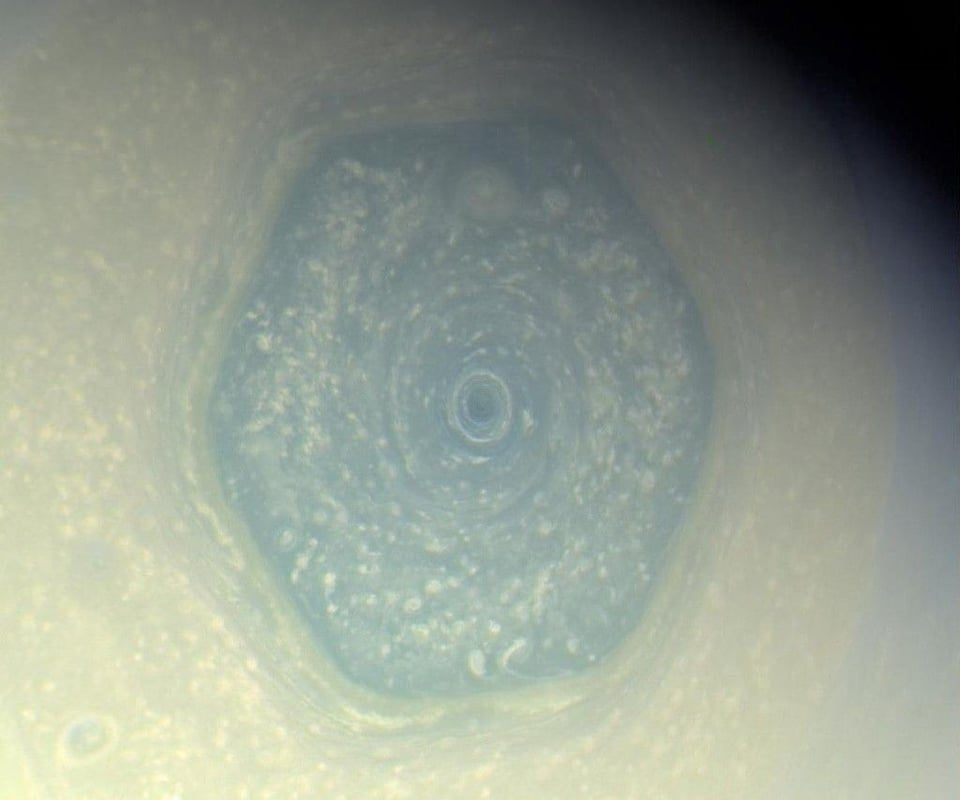
Saturn’s north pole is home to a giant hexagonal storm about 30,000 km (18,600 miles) wide—large enough for more than two Earths to fit inside. First spotted in 1980, it’s still raging today.
The wonders of our solar system never cease to amaze me, and one of the most fascinating sights out there has to be the giant hexagonal storm swirling around Saturn’s north pole. I mean, can you imagine a storm so massive that it could swallow two entire Earths whole? That’s exactly what we’re dealing with here – a colossal weather system that’s been raging for decades, and yet, it still manages to capture our imagination and inspire our curiosity. First spotted back in 1980, this incredible phenomenon has been a subject of interest for scientists and space enthusiasts alike, and for good reason – it’s a truly one-of-a-kind feature that sets Saturn apart from all the other planets in our celestial neighborhood.
The Science Behind the Storm
The hexagonal storm at Saturn’s north pole is a remarkable example of atmospheric physics in action. The storm is essentially a giant, rotating pattern of clouds that’s sustained by winds that can reach speeds of up to 320 kilometers per hour (200 miles per hour). But what’s really interesting is the shape of the storm itself – a perfect hexagon that’s remained remarkably stable over the years. Scientists believe that this unique shape is due to the way that the winds interact with the planet’s rotation and the surrounding atmosphere, creating a kind of self-reinforcing pattern that’s able to maintain its shape over long periods of time.
A Long and Fascinating History
So, how did we first discover this incredible storm? Well, it all started back in 1980, when NASA’s Voyager 1 spacecraft flew by Saturn and sent back some stunning images of the planet’s north pole. At the time, scientists were amazed by the hexagonal shape of the storm, and they quickly set to work trying to understand what was causing it. Since then, we’ve learned a lot more about the storm, thanks to subsequent flybys by other spacecraft, including the Cassini mission, which orbited Saturn from 2004 to 2017. Today, we know that the storm is a permanent feature of Saturn’s atmosphere, and it continues to fascinate scientists and space enthusiasts alike with its sheer scale and enduring presence.
Why This Storm Matters
So, why should we care about a storm on a distant planet? Well, for one thing, the hexagonal storm at Saturn’s north pole is a reminder of just how much we still have to learn about our solar system and the amazing phenomena that it contains. By studying this storm and others like it, scientists can gain insights into the atmospheric physics of other planets, and even learn more about the potential for life beyond Earth. Plus, let’s be honest – it’s just really cool to think about a storm that’s been raging for decades, and yet, it still manages to capture our imagination and inspire our sense of wonder.
As I sit here thinking about the giant hexagonal storm at Saturn’s north pole, I’m struck by the sheer awe-inspiring scale of our solar system, and the many mysteries that still remain to be uncovered. This incredible storm is just one example of the amazing phenomena that are out there waiting to be explored and understood, and it’s a powerful reminder of the importance of continued space exploration and research. Who knows what other secrets our solar system still holds, and what other wonders await us as we continue to venture forth into the cosmos?